







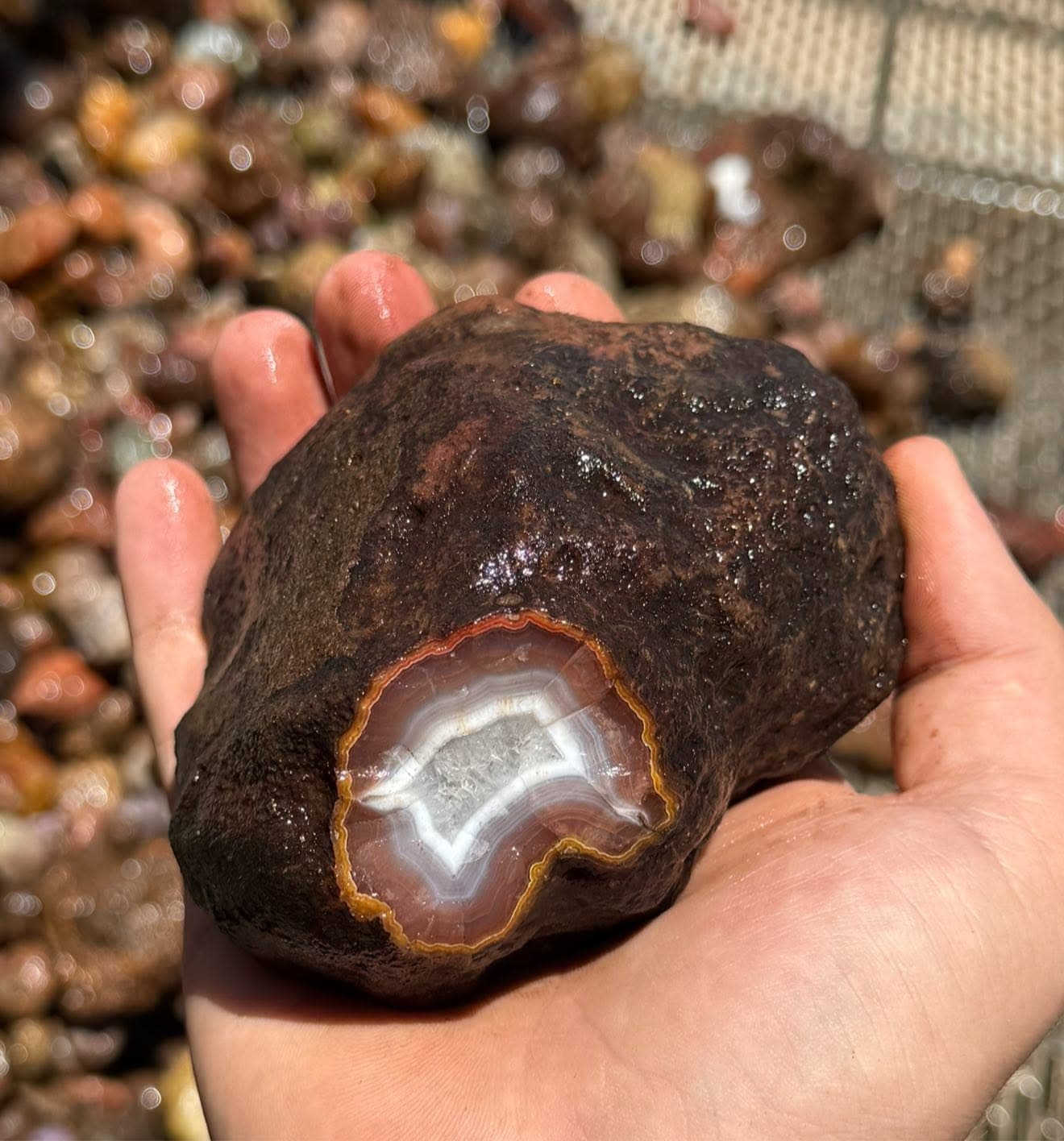
Every agate in the Agates From Mexico collection started as nothing. Not a crystal, not a mineral. A pocket of trapped gas inside molten rock. A bubble. The kind that disappears from a glass of soda in two seconds.
These bubbles didn't disappear. They became some of the most beautiful natural objects on Earth.
Here's how that actually happens.
The volcano
About 38 million years ago, a series of volcanic eruptions covered what is now Chihuahua, Mexico in flows of hot lava. As that lava cooled and hardened, the gases dissolved inside it had nowhere to go. They formed bubbles, billions of them, frozen in place as the rock solidified.
Some were tiny. Some were the size of a marble. A few were the size of a fist. Each one became a hollow cavity in the rock, called a vesicle.
Empty rooms. Waiting.
The water
Over thousands and then millions of years, groundwater seeped through that volcanic rock. This wasn't ordinary water. It had been moving through volcanic minerals for a long time, picking up dissolved silica along with traces of iron, uranium, and other elements.
When that silica-rich water found its way into the vesicles, something interesting happened. Under the right temperature and pressure conditions, the dissolved silica started coming out of solution and depositing on the cavity walls.
Not all at once. One thin layer at a time.
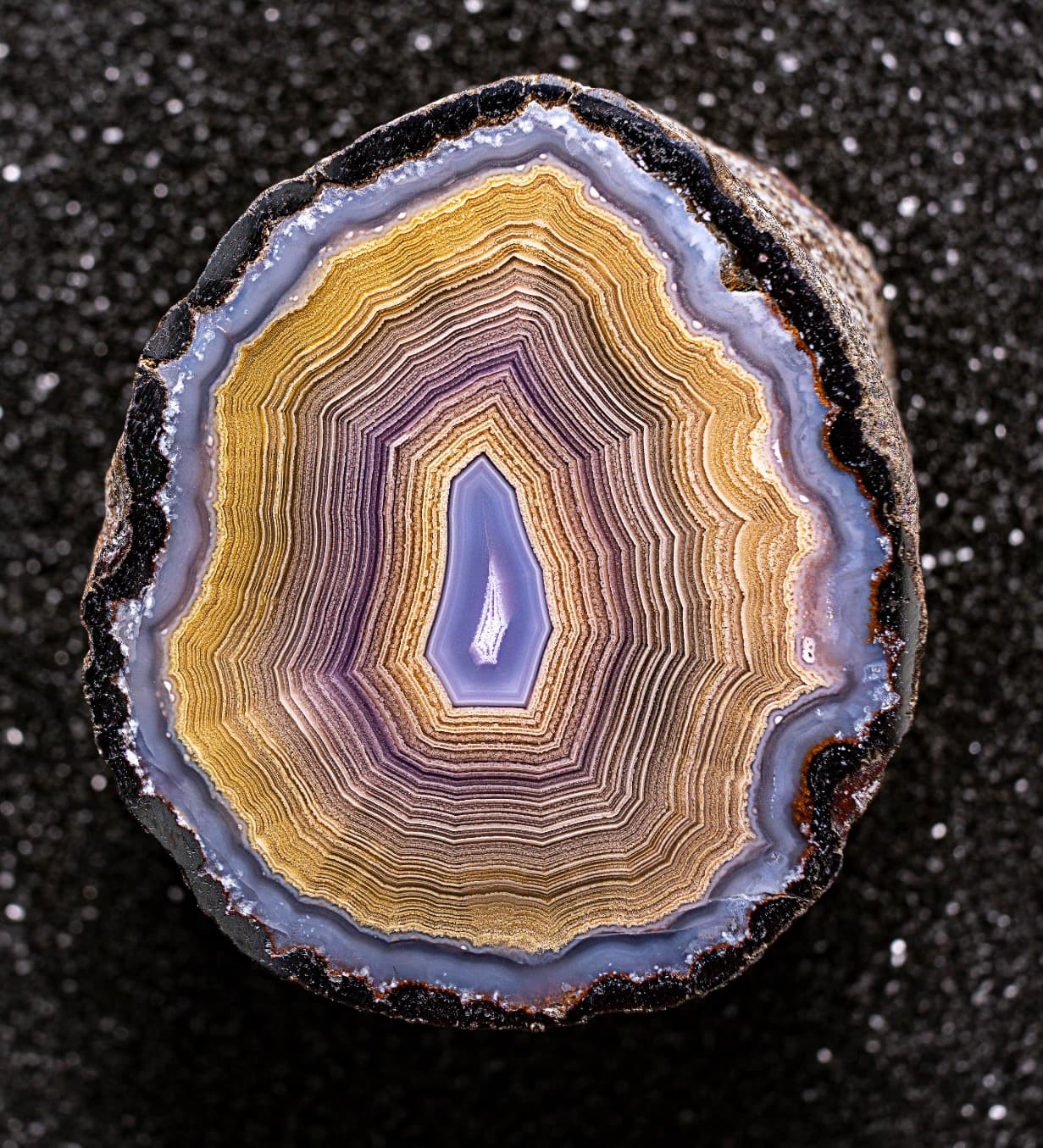
Each layer is chalcedony, microcrystalline quartz, the mineral that makes up agate. Each layer represents one moment in time: one pulse of water, one shift in chemistry, one layer added to the record.
The bands in a Laguna agate can number in the hundreds. Each one is a different chapter.
The colors
If silica were the only ingredient, every agate would be white or gray. The colors come from trace elements carried by the water.
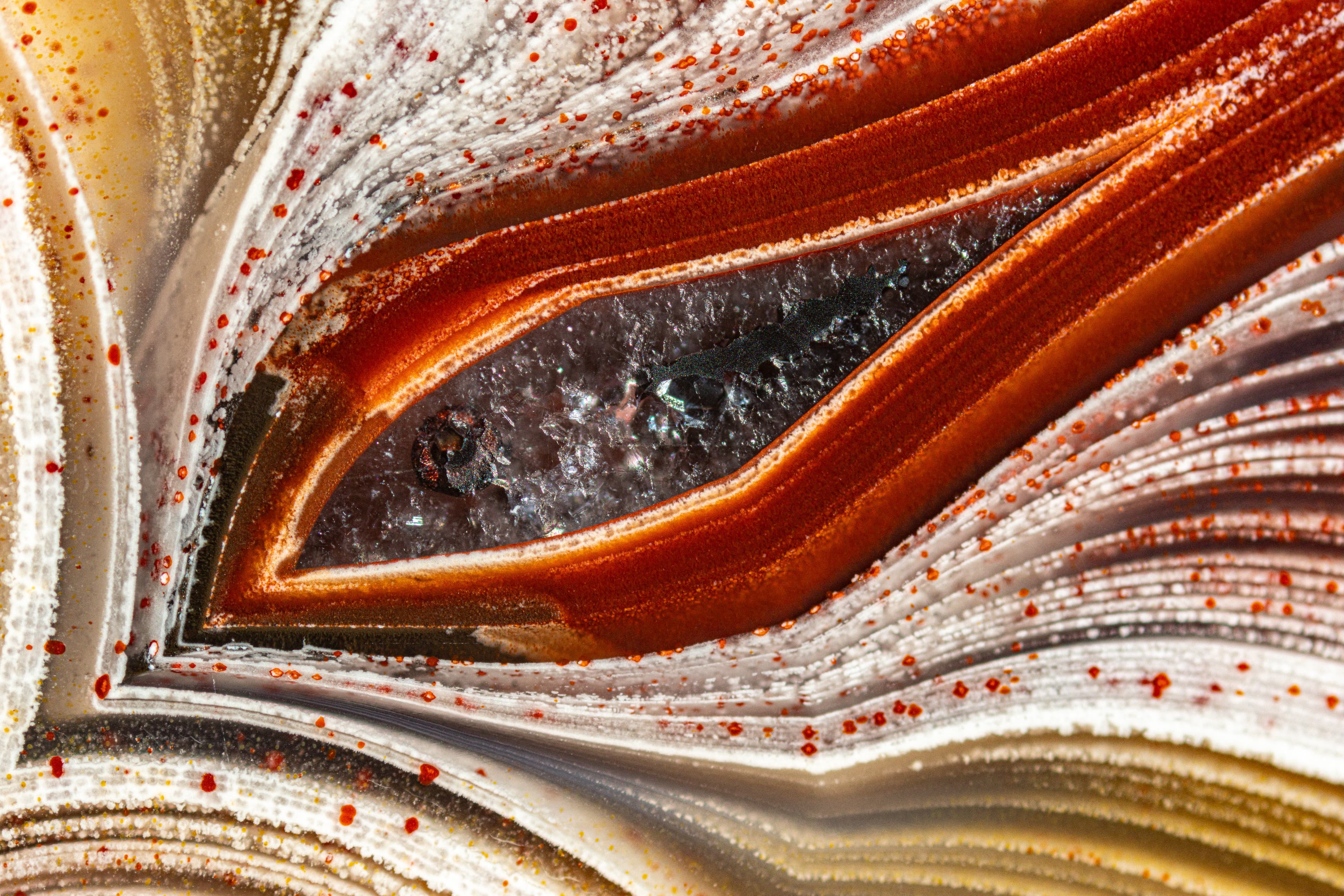
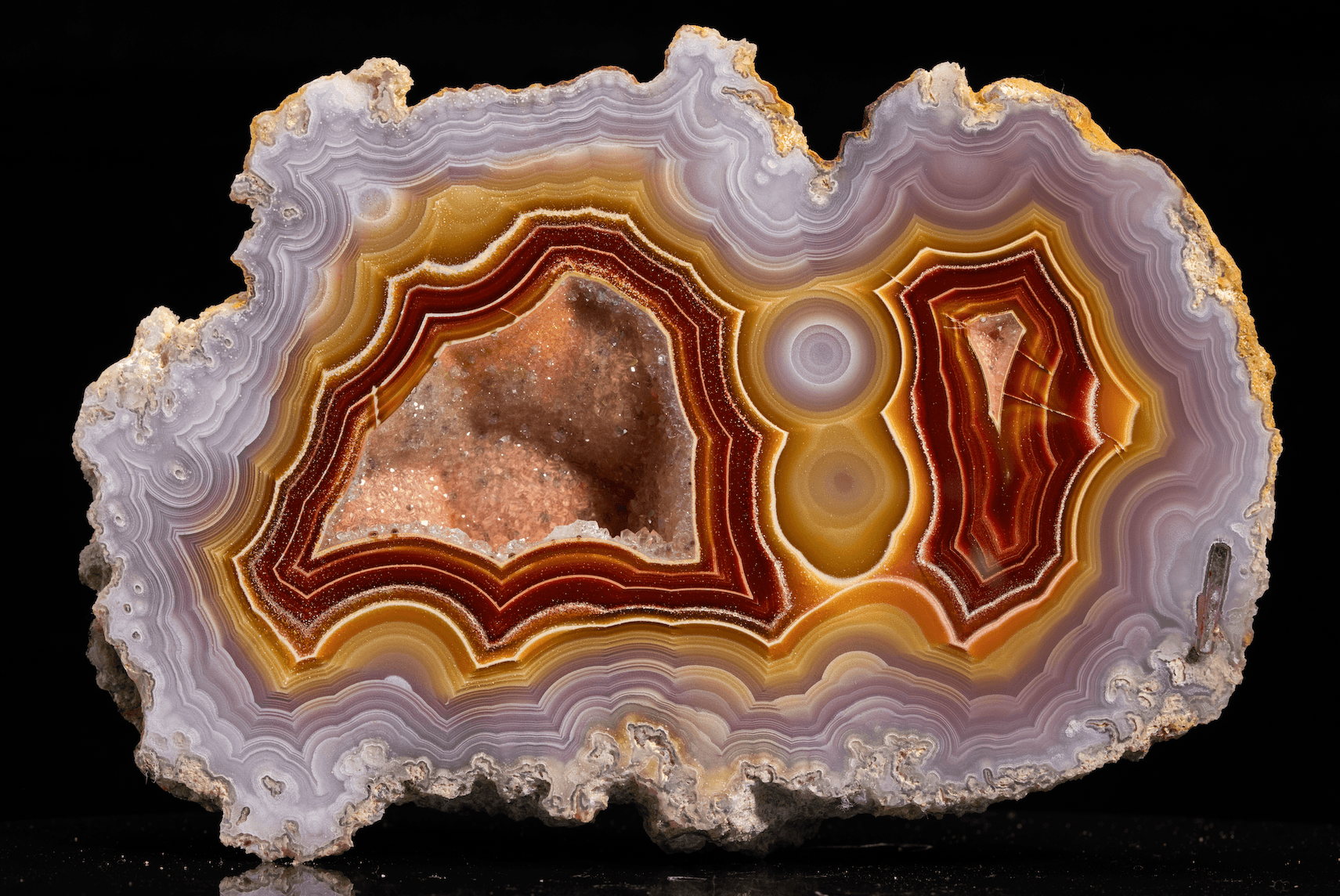
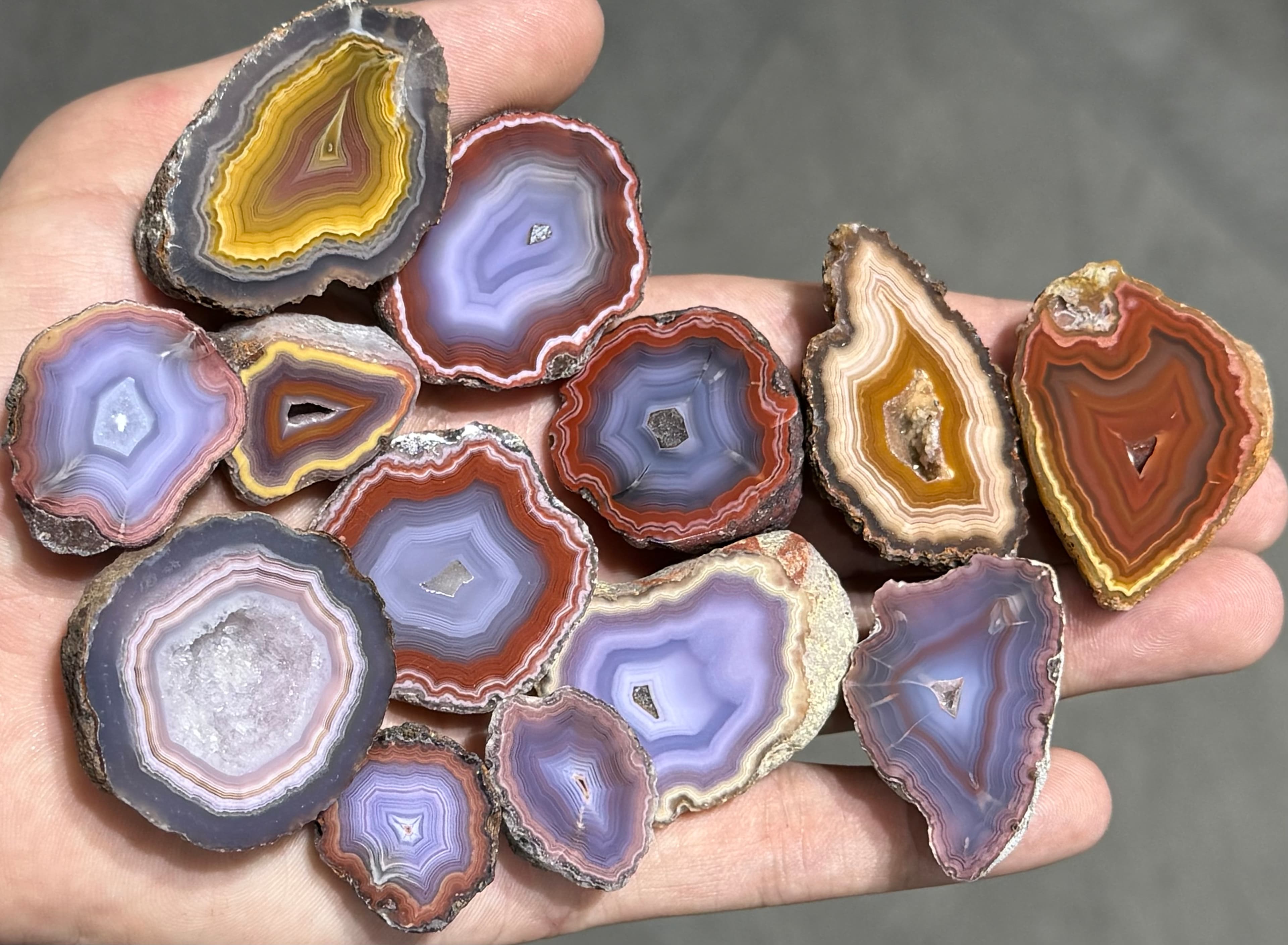
Red bands come from hematite, microscopic iron oxide particles trapped between chalcedony layers. Yellow bands come from goethite, another iron mineral with a different structure. Violet bands, the rarest, come from something more unusual: iron atoms built directly into the quartz crystal lattice, transformed by natural uranium radiation over millions of years. That's the same mechanism behind the color in amethyst, and it's the first time it has been scientifically confirmed in chalcedony — documented in Coyamito agates by researchers at TU Bergakademie Freiberg in 2026.
Same element, iron, three completely different colors, depending on how it ended up in the stone.
What the deposit leaves behind
The basic process is the same across all five Chihuahua deposits. But what each one produces is different — because the local volcanic chemistry was different, the trace elements in the groundwater were different, and the conditions inside each cavity were different.
At Laguna, the banding is so precisely parallel and finely spaced that it creates something you can't photograph. Tilt a good Laguna piece and the bands appear to shift and float at different depths, a 3D illusion from a completely flat surface. That's parallax, and no other deposit in the world produces it as consistently or as strongly.
At Coyamito, something stranger happened in certain cavities. Before the silica arrived, other minerals — mostly aragonite, a form of calcium carbonate — had already grown inside. The silica replaced those crystals molecule by molecule over millions of years. The original mineral dissolved completely. Agate took its place. But it kept the exact geometric shape.
The result is called a pseudomorph. Cut one open and you'll see angular forms inside that look nothing like natural banding. Those shapes are fossils of minerals that no longer exist, preserved in chalcedony. Pseudomorphs after aragonite are extremely rare worldwide. Coyamito is one of the very few places where they occur with any regularity.
Not every piece has these features. Parallax depends on banding precision. Pseudomorphs only form where the original conditions were right. That's part of what makes exceptional material exceptional.
The end
At some point the silica-bearing water stopped coming. The cavities sealed. Some filled completely and became solid nodules. Some filled only partway and became geodes, the open center lined with sparkling druzy quartz.
And then they waited. Millions of years in the dark, inside the volcanic rock.
We cut them out of that same rock at the deposits in Chihuahua. Each piece is evaluated, and the ones that earn it get polished to show what's been hidden since before the first primate stood upright.
The process that made them is done. The process of finding them isn't.
How long ago, exactly
38 million years is hard to picture. Here's some context.
When these agates started forming, horses were the size of border collies. Whales still had hind legs. Crocodiles lived in the Arctic. The Sahara was a rainforest.
The volcanic eruptions that created these cavities happened in that world. The silica started filling them shortly after and kept going for millions of years. These agates have been sitting in their host rock, finished and undisturbed, for longer than the Himalayas have been at their current height.
When you hold one of these pieces, you're holding something that predates almost every familiar feature of the modern world.
---------------------------------------------------------------------
Source: Götze, J., Mrozik, M., DeCorby, M., Pan, Y. & Wildner, M. (2026). Origin of violet colour in agates from Chihuahua, Northern Mexico. Mineralogy and Petrology. https://doi.org/10.1007/s00710-026-00977-x — Open access, free to read.